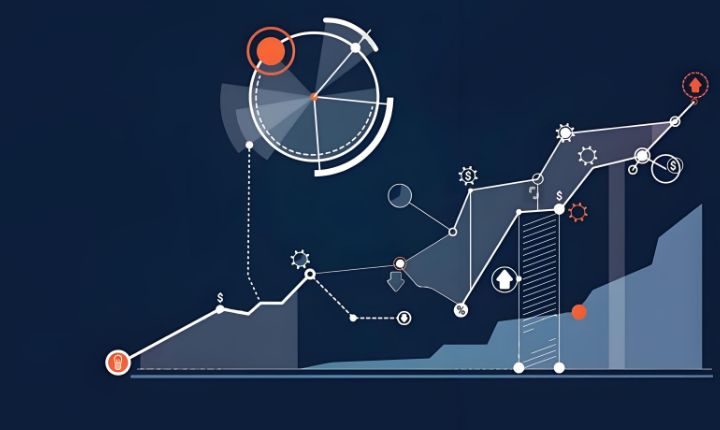
With the development of volatility trading, financial markets are entering a new stage. In the past, trading relied mainly on experience and intuition, but today markets increasingly favor financial technology–driven data-driven trading and algorithmic models. Through the enhancement of big data and computing capabilities, traders can analyze market changes more precisely and improve the scientific nature of trading decisions. This transformation not only changes trading methods but also provides ordinary investors with more tools to understand and participate in financial markets.
In the future, trading environments will rely more on intelligent trading and automated strategies. Institutional investors have long used quantitative models to trade, searching for market opportunities through mathematical and statistical methods. Compared with traditional trading approaches, intelligent trading can process massive amounts of data quickly and reduce the impact of human emotions on decision-making. For example, when market volatility increases, algorithmic models can adjust strategies based on real-time data and improve execution speed. This approach is becoming mainstream and driving markets toward greater efficiency and transparency.
Technical analysis will continue to play an important role in future trading, but its form is evolving. Traditional price and volume analysis remains effective, yet when combined with artificial intelligence and data models, analytical capabilities are significantly enhanced. For instance, AI can identify hidden patterns in historical data and provide trading suggestions. This means traders can not only observe surface-level market movements but also understand underlying drivers. By combining technology with data, trading decisions become more scientific and predictable.
However, technological advancement cannot eliminate trading risks. Risk management remains the core of successful trading. Market volatility is unpredictable, and even advanced algorithms cannot guarantee profitability in every trade. Therefore, stop-loss strategies, position management, and asset diversification remain essential. Successful traders focus on long-term stable returns rather than short-term windfalls. Financial markets present both opportunities and risks, and scientific risk control is the key to long-term survival.
Investment strategies will also adjust as market conditions change. High-volatility markets are suitable for short-term and swing trading, while low-volatility markets are better for trend and long-term investment. Future investors must possess the ability to flexibly adjust strategies rather than relying on a single fixed method. As market environments evolve, strategies must be optimized accordingly. Only through continuous learning and adaptation can traders maintain competitiveness in complex markets.
Overall, intelligent trading and data-driven analysis are reshaping the financial industry. Trading is no longer the exclusive domain of large institutions; ordinary investors can also enhance their trading capabilities through technological tools. However, technology is only an aid—final decisions must still consider market logic and risk evaluation. The essence of financial markets has not changed, but trading methods are upgrading.
The future belongs to data and intelligence, yet success still depends on learning and adaptation. Data-driven trading and intelligent analysis will become mainstream, and traders must continuously optimize strategies to respond to market changes. Financial markets are full of opportunities, but only scientific methods and disciplined execution, supported by risk management, can achieve long-term stable returns. Mastering new technologies and market principles is an important path to success.